

March 2009
By Jamuna Rangachari
Despite threats to his life and trumped up charges, Elango Ramaswamy is testimony to the change one man can bring in a corrupt system, by using Panchayat Raj as a tool to build strong local economies
KuthamBakkam: Some Facts
Kuthambakkam village is about 30 km from Chennai on the road to Tirupati. Soon after, passing Tirumazhisai, turn left off the highway at Vellavedu and you begin the pleasant drive to Kuthambakkam.
The Panchayat covers a 36 sq km area. It has a population of 5000 people in 1040 households spread over 70 hamlets. Kuthambakkam itself is a delightful village with numerous ancient small temples. Clearly, it is a long-lived habitat. A vast lake irrigates 1400 acres. Agriculture is practised in another 700 acres, which are rain fed. Water conservation has clearly been a part of its heritage. Elango’s leadership continues this tradition.
Though 55 per cent of the population are Dalits they own only two per cent of the productive land. There is only one Muslim family and about four per cent are Christian. Caste barriers have not completely broken down but at least there is no animosity. Last year, there were about six inter-caste marriages. There are 10 college graduates now.
Website – www.goodnewsindia.com
Quitting a mainstream career and taking up village governance would not be considered a smart option, but Elango Ramaswamy could not be happier with his choice.
He was posted to a site in Orissa after he got a job with Oil India, but his heart remained in his village. Soon, Elango married and had two children. By then Elango had visualised a long-term road map. He and wife, Sumathy, had many conversations and agreed on a plan. They would make a home in Chennai, he would take care of the children, and she would do her Master’s in Chemistry. Then she would find a job and provide for the family and he would return permanently to the village. He speaks feelingly of her, “I can’t quite estimate her contribution to whatever I have done. Until I began getting some money from an Ashoka Fellowship in 2002, she has been the breadwinner. She has supported the family for over a decade without a murmur and raised our two girls.”
In 1994, Sumathy got a job in the Oil and Natural Gas Commission (ONGC) and Elango promptly quit his job, becoming a leader of India in the true sense of the word. “Dignity, and not mere comfort, is the purpose of providing toilets in every home,” says Elango Ramaswamy, while showing us the toilet being built in the village by the villagers themselves.
As we go further, we notice village women gainfully employed in putting together spare parts for manufacturers, while in a separate area, building tiles are being manufactured.
Chatting merrily and even taking a break for lunch, the villagers are happy that they have been able to avoid a long commute or migration to the crowded city for employment.
“When companies wanted to employ people, we gave them an option of setting up a small unit here,” is Elango’s axiom, which has clearly been effective.
The green fields around us stand testimony to the fact that development and ecological balance can be maintained with a vision that considers both the short-term and long-term implications of any act.
“Individual happiness is impossible when there is misery all around,” he believes. With this, he has chalked out the path of his own life and that of the entire village. Excerpts from the interview
What were the reasons that made you quit your mainstream career and take up village governance?
There is no meaning in crying from outside leaving the power with the bad politicians. Though I was gainfully employed, I was keen on finding solutions for rural problems like wife-beating, illicit arrack distillation, drunken men disrupting the village, exploitation by politicians, poverty, caste-based differences, enmity among village communities, and general backwardness in the village. These were the reasons for my eagerness to return to the village. Instead of working as a volunteer, I tried to use the panchayat raj system as a tool to develop the village. I think it is the closest governing system and the real meaning of democracy. With this in mind, I quit my job (with Oil India) and got involved in village level politics.
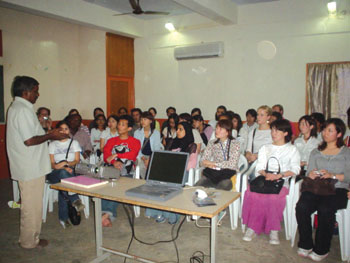 Urban India could learn the participatory development process from rural India |
What were the main challenges you faced and how did you overcome them?
Convincing my family was a big problem as supporting the family was also important. At this stage, luckily, my wife got a job with ONGC. It was also difficult to convince the parents. Contesting in the panchayat elections and convincing people to vote for me without spending money and giving liquor was quite tough. After winning, organising people for participation in gram sabhas and convening the gram sabhas were the challenges. In six months’ time facing the corrupt practices of the Panchayat Raj system was the challenge. I was crippled by not paying bribes like other panchayat leaders. I was suspended from the post and faced charges of corruption from the corrupt bureaucracy. At this stage, Gandhian principles of ‘Be truthful and be fearless’ were my anchor. I stood firm and approached the higher-level authorities with all the facts. My stand was vindicated and I was reinstated.
Another issue emerged when illicit arrack brewers threatened to kill me. With strategic support from government officials and support from the villagers, I overcame the troubles. Likewise, the land-grabbing mafias tried to stop the Samathuvapuram programme of the government, which provides for building hamlets with twin housing facilities where every alternate house is that of a Dalit, thus encouraging intermingling of communities. However, with transparency in selection of beneficiaries and transparent spending of money, this programme later earned great respect from the people.
We hear you have started a panchayat academy to train other village leaders. What is the progress made in this direction?
In 2006, we used this village as a model for others to learn. Right now, we are aiding around five villages to replicate this who in turn will also be models for others. With this, we hope to have an impact on two hundred villages in Tamil Nadu.We have also been networking with villages in Andhra Pradesh, Karnataka, and Rajasthan.
Do you feel effective village governance has the potential to transform India?
Effective village self-governance is the only solution for villagers to grow. I am hundred per cent sure of this. India will be strong only when every village grows and becomes self-reliant.
Do any obstacles remain? How do you plan to address them?
Many times fighting with the state government departments to prevent the acquisition of fertile village land for housing purposes or for industrial application remains a challenge. Motivating the village people to take bank loans and making them repay the loans regularly is an ongoing struggle. Getting acceptance from the government officials for applying innovative solutions is a day-to-day challenge. The government’s plan to grab our panchayat lands for other unwanted developmental programmes is also a stumbling block. The solution lies in getting the people to spend time and energy to tackle these problems together.
What are the lessons urban India can learn from rural India?
Urban India could learn the participatory development process from rural India, where the needs of the entire community are addressed.
Do you feel a new world order can be shaped by small self-governing units like that of Kuthambakkam?
Certainly, the new world order would become possible with independent self-sustaining village-based strong local economies. The bargaining power of the villages will be rejuvenated by strong village-centred economies and ecologically sound sustainable growth would be the order of the future.
Any message for young Indians?
The youth of this country should understand the role and importance of building the life of more than a billion of their fellow Indians. No doubt, they should excel in various fields but also commit themselves to undertaking activities which are not focused on money alone.
We welcome your comments and suggestions on this article. Mail us at editor@lifepositive.net
