

March 2013
By Yoginder Sikand
Yoginder Sikand wistfully recalls the years gone by when a person’s livelihood was not merely a tool of survival but an age-old way of life
 |
Yoginder Sikand wistfully recalls the years gone by when a person’s livelihood was not merely a tool of survival but an age-old way of life For all I know, they must all have joined the bursting ranks of India’s unemployed or grossly under-paid manual labor force. Dozens of occupations, which were valued sources of livelihood for millions of people, have now become almost totally extinct, swallowed up by the seemingly uncontrollable phenomenon politely termed as ‘modernization’, ‘development,’ or ‘globalization’. Occupations that were not simply a means of survival but also a centuries’ old way of life for many have been taken over by multinational companies, rendering vast numbers of people unemployed. Growing up in a middle-class locality in Kolkata half a century ago, many of the services for which people hop across to the impersonal neighborhood supermarket today, were delivered, quite literally, at one’s own doorstep. There was the bread-wala, who would come to your home early in the morning on his bicycle, which was laden with loaves of freshly baked buns and bread. He would even slice the bread for you if you did not want an entire loaf. There was the doodh-wala, who would arrive at around the same time along with his cow, which he would milk in front of you to assure you that the milk was not adulterated. The chhuri-wala would wander in the streets with his bicycle-wheel that he had cleverly turned into a knife-sharpening contraption. In addition, the razai-wala, bearing his peculiar instrument that was shaped like an enormous one-stringed harp, on which he would fluff out the cotton wool you would give to him to fill up your mattresses and quits. There was the sonar, the goldsmith, who would arrive home armed with his little wooden box with glass panels, a pair of weighing scales, and for housewives, jewelry-design books to indicate their choices.
| That was the blissful time of no TV, when children like us had other ways to entertain ourselves | ||
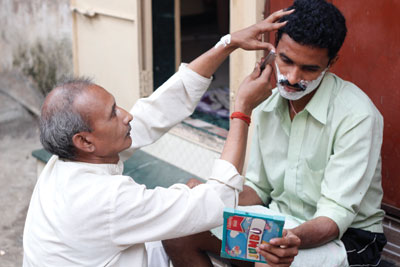
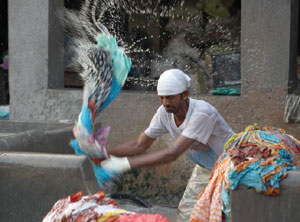
The barber would make his rounds of the locality with his worn-out suitcase that contained his implements. Then, there was the jhadoo-wala, who would roam in the lanes peddling his wares, brooms made of rice stalks and straw, dusters made of chicken feathers and long poles with fluffy ends to clean out cobwebs high up on the walls. There was the ear-cleaner, who would saunter around with his wooden tray filled with needles and bottles of oil. There was the darzi, the neighborhood tailor, who would come home to take your measurements, and to show you his sample book with the latest designs, the sari-wali, peddling her little bundle of hand-woven saris, and the dhobi, the washerman (washing machines were still many years away). There were enormous, arrestingly handsome Kabuli-walas, moneylenders from all the way in Afghanistan, who would come occasionally to recover their loans, and to offer small amounts at exorbitant rates of interest, to poor folks who did not know what banks were (there were hardly any banks, in any case, in those days). There was the kumhar, who would carry an enormous load of mud plates, pots, jars, and little sun-baked mud toys and piggy banks, on his back. There was also the ubiquitous subzi-wala. In some parts of urban India, he still manages to exist today, despite the allure of the hypermarket, with his cart laden with fresh vegetables and fruit. That was the blissful time of no TV, when children like us had other ways to entertain ourselves. On the streets of Kolkata, a host of performers provided lively entertainment for a small fee. There were jugglers, acrobats, and magicians, who would gather large crowds on street corners. Jogis or saperas, dressed in flowing ochre robes, onion-shaped turbans, enormous earrings, and telltale, richly embroidered cloth bags and flutes shaped from dried gourds, would squat on the roadside and regale awe-struck spectators with their dancing snakes. As did the bandar-wala, with his pair of monkeys, dressed in torn frocks and pants, and the bhalu-wala, with his miserable hirsute Himalayan black bear driven almost mad in the fierce semi-tropical Kolkata heat. There was the view-wala, who would go from house to house with his giant contraption that had large hole-like windows, through which you could view pictures of amazing places you had only heard of. And then, of course, there was the khilauna-wala, peddling his jumble of simple, low-cost toys that were strung together on a lengthy pole, balloons, whistles, wooden toy cars, bamboo pipes, ribbons, paper hats Jacks-in-the-box, and many other such wonderful things that children like us could only rarely afford.
 |
It was, quite literally, a different world then. We did not know the names of most of the men and women who came to our doorsteps to deliver these valuable services. We simply called them by their occupations, such was the hiatus which the caste system, still largely intact, engendered, and the vast majority of these people must have been from the so-called ‘low’ castes. Yet, there was often something of a personal bond built between us, based on regular, face-to-face interaction, which could stretch over many years, and which could sometimes become a close relationship. Life was relatively unhurried and relaxed then. Time was not considered to be just money, and money was not considered to be almost everything, and so you did not think it irksome or odd or a sheer waste to spend half an hour chatting about this and that with the milkman or the dhobi the first thing in the morning. Moreover, you did not think twice to help the subzi-wala who had been visiting your home, day after day for over a decade, with money when he needed it for an operation that his father was to undergo. It was not at all like today. You step into a supermarket, hurriedly purchase whatever you need, hand over your credit card to a wooden-faced employee whom you don’t know or want to recognize, and then slip out. No smile or a few polite words or even thanks are exchanged between the two of you, the process being entirely mechanical and strictly impersonal.
