

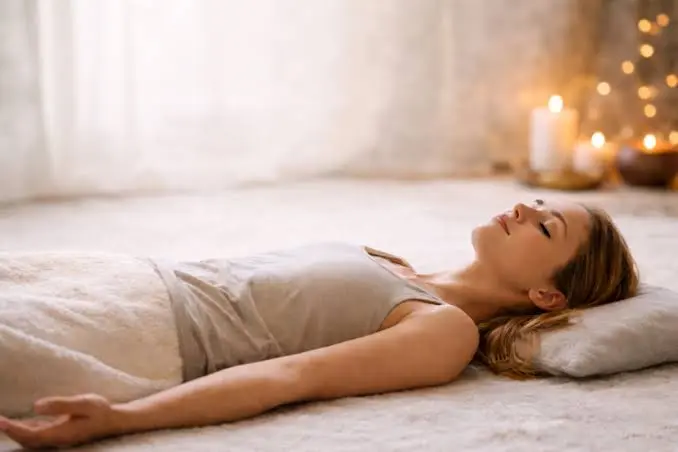
Yoga Nidra is a powerful conscious relaxation technique that guides the mind into a state between wakefulness and sleep, deeply restoring both the body and nervous system.
Living in a world of constant notifications, hectic schedules, and not enough time to stop and breathe, getting true rest might seem to be tough. Yoga Nidra, which is also called yogic sleep, provides an alternative option. Unlike other forms of yoga practice that require rigorous physical exercises, this guided meditation helps the person feel relaxed and focus inward without having to take any strenuous positions.
It can be performed in the Savasana position, where the practitioner is resting in a comfortable position.
Key Takeaways
- Promotes Conscious Rest: Induces deep mental and physical relaxation while maintaining full awareness.
- Reduces Anxiety & Insomnia: Calms the nervous system to relieve chronic stress and improve sleep quality.
- Accelerates Mind-Body Recovery: A short session delivers restorative benefits equivalent to hours of sleep.
What Is Yoga Nidra?
Yoga Nidra is a guided meditative relaxation practice in which the practitioner remains physically still while following a systematic sequence of awareness. The practice may involve attention to different parts of the body, breathing, sensations, and thoughts.
| Aspect | Yoga Nidra |
| Meaning | Yogic sleep |
| Usual position | Savasana or another comfortable supported position |
| Main approach | Guided awareness and deep relaxation |
| Physical intensity | Very low |
| Breathing | Natural and mindful |
| Common duration | Can range from a few minutes to longer sessions |
| Suitable for | Beginners as well as experienced practitioners |
Benefits of Yoga Nidra
Some of the benefits of yoga nidra are as follows:
| Benefit | How Yoga Nidra May Help |
| Promotes deep relaxation | Encourages physical stillness and helps create a state of deep rest. |
| Helps manage stress | Guided awareness and mindful breathing may help reduce mental and physical tension. |
| Supports better sleep | Its relaxing nature may help prepare the body and mind for restful sleep. |
| Encourages mental calmness | Directing attention inward can reduce distractions and promote a calmer state of mind. |
| Improves self-awareness | Body scanning and mindful observation encourage greater awareness of sensations, thoughts, and emotions. |
| Supports emotional balance | Regular relaxation practice may help practitioners respond to everyday emotional stress more calmly. |
| May improve concentration | Following a structured sequence of awareness can encourage sustained attention. |
| Releases physical tension | Remaining comfortably supported while observing different parts of the body can encourage relaxation. |
| Accessible to most beginners | Yoga Nidra requires little physical movement and can be adapted to different comfort levels. |
| Supports mindfulness | The practice encourages present-moment awareness rather than constant engagement with external distractions. |
| Encourages inner reflection | Quiet periods of guided awareness can create space for self-observation and contemplation. |
| Complements physical yoga | It can be used after an asana practice to transition from physical activity into relaxation. |
How to Practise Yoga Nidra
Beginners can practice meditation in a guided meditation practice.
- Pick an environment where you won’t be disturbed easily.
- Lie in a relaxed position, preferably in Savasana pose.
- Use a cushion or blanket to support your body, if necessary.
- Shut your eyes and let your breathing be natural.
- Let the instructor guide you instead of controlling your mind.
- Shift your focus as per the instructions of the instructor.
- Pay attention to your breathing and sensations, without judging them.
- Stay relaxed during the whole meditation session.
- Slowly shift your focus back towards the surroundings.
If lying on the floor is uncomfortable, Yoga Nidra can be adapted to a seated position.
Precautions for Yoga Nidra
While Yoga Nidra tends to be a mild process, some simple precautions will make it easier.
- Select a position that causes neither pain nor stress.
- Utilize cushions, bolsters, and blankets for support where necessary.
- Perform Yoga Nidra in a safe and comfortable environment.
- Do not force yourself to stay still when you feel physically uncomfortable.
- When emotional experiences become too overwhelming, stop the process and contact professionals.
- Individuals with particular medical or psychological conditions should consult with professionals on how to relax appropriately.
Summing Up
Yoga Nidra brings something unique to life in this day and age: it gives you the opportunity to stop. It does not require difficult poses, extreme flexibility, or special preparation. It just takes being comfortable and listening to instructions to create the space for rest and contemplation.
Whether used as an interval in the middle of a stressful day, or as part of your evening routine and even as a component of your existing yoga practice, Yoga Nidra could be a way of connecting with yourself. And after some practice, these little pauses could become a very good lesson about the importance of rest – that it is not idle time, but an essential element of balance and harmony.
FAQs
1. Does the term Yoga Nidra mean sleep?
Not quite. Even though it is termed as yogic sleep, Yoga Nidra is usually done in a guided practice of profound relaxation and inner awareness, and not as regular sleep.
2. Can beginners practice Yoga Nidra?
Yes. It doesn’t involve being highly flexible or having knowledge of hard yoga postures. One can start as a beginner by taking up a guided practice for some time.
3. Can Yoga Nidra be practiced prior to sleep?
Yes. Being a very quiet and relaxing process, it makes for a good inclusion in your evening routine.
4. What should I do if I go to sleep in the middle of Yoga Nidra?
It may happen at times because of the profound relaxation of the body. If your aim is to carry out the whole meditation practice, then you can try it when you are more awake.
Disclaimer: The content on LifePositive.com, including articles/blogs on yoga, acupuncture, naturopathy, and other alternative healing modalities for holistic wellness, is for informational and educational purposes only. It is not a substitute for professional medical advice, diagnosis, or treatment. Always consult a qualified healthcare provider before starting any new health protocol or making changes to an existing treatment plan.
Also Read: Types of Yoga
By Umesh Kumar Khiri
