

January 2024
LEAD STORY
Astrology Unravelled
A lot of confusion and scepticism plague astrology, a discipline that has been practised by pundits ever since Vedic times. Through this well-researched article, Nitya Rajagopal brings the much-needed clarity to the subject matter and lifts the fog surrounding it, thereby rescuing it from the realm of superstition to which it has been relegated by some.
What comes to mind when you hear the word ‘astrology’? Is it something that draws your curiosity or something you prefer not to engage with? Is it a valuable source of knowledge or a practice for the superstitious?
Personally, for most of my life, astrology was mainly a form of diversion or entertainment. Growing up, my friends and I would explore astrology for fun. We would read different books about zodiac signs and then compare the characteristics of each person’s zodiac sign to their personality, often with surprising or amusing results. At times, we would pore over the daily newspaper and go through the daily or weekly forecast for each one’s sign. For those of us entering the world of love and relationships for the first time, zodiac sign compatibility became a guide in the face of our obvious lack of experience. Whether the zodiac compatibility was an accurate representation of the real compatibility of the two people in question or not, it didn’t matter. What mattered is that we had a guide of some sort, a kind of framework to understand our own nature and that of others, and that in itself made us feel empowered.
As we grew up and entered adulthood, many of us found ourselves faced with more uncertainty and doubts than ever. What should I study? What career should I choose? And as time passed, the questions grew more complex. Should I change careers? Should I leave my job to start my own business? Is the creative path right for me? Will challenges in my relationship resolve themselves, or is it better to break up? Should I marry this person? Is now the right time to get married, or should I wait a few more years and focus on my career? And perhaps, the biggest question of them all—What is the purpose of my life? What am I here for?
These questions can be daunting, leaving a person feeling derailed, and can even bring great stress, especially when no solution appears obvious or forthcoming. It is precisely in such situations that astrology can bring us the wisdom, insight, and clarity we seek. Yes, we can still talk to family members, trusted friends, teachers, and mentors or a counsellor or therapist. They are also important and must not be discounted. But what astrology can bring us is an overall, birds eye view of our lives, providing us with a roadmap and a clear idea of the options available to us so that we make conscious choices and create our lives in an empowered manner.
There’s no question that the subject of astrology gives rise to diverse reactions. If you walk into a room full of people and ask the question, “What do you think about astrology?” you are likely to encounter a spectrum of answers, ranging from die-hard belief to die-hard scepticism. Some consult their charts for every life decision, whether major or minor, while others dismiss the whole thing as superstition.
In India, astrology is embedded in our culture. While it is respected by some, it is perceived by others as a rigid, fear-based, and archaic practice. It is mostly associated with predictions of imminent events in our lives. For many people, astrology implies information, in the face of which we are powerless.
Perhaps this is why the topic of astrology is so divisive. For those who believe that life is largely predestined, astrology is an area of natural affinity. However, for those who believe that they can shape their destiny through their thoughts, words, and actions, and have experienced this for themselves, astrology seems like a fatalistic science.
The truth is that life is a mix of destiny and free will. And while there are some things in life that we may not be able to change, a large part of our life experience lies in our own hands. If we want
to have a rich and fulfilling experience of life, we must take responsibility for ourselves and own our power to create our reality.
Counselling approach
So is astrology still relevant for those who are committed to shaping their destinies through their own efforts? Absolutely. In fact, I was surprised to learn that in ancient times, Vedic astrology was used as a tool for counselling, not only for material but also for physical, psychological, and spiritual purposes. And although this approach has dwindled today, both among seekers and practitioners of astrology, who are often unaware that such a possibility even exists, there are still astrologers out there who are committed to reviving this approach.
Sai Ganesh Nagpal, a Vedic astrologer, devotional music artist, and educator, shares, “The counselling approach to astrology isn’t limited to just predictions. When we approach Vedic astrology as a spiritual counselling tool, we attempt to understand the deeper nature of
our current and upcoming time and the many ways in which we can co-create our reality along with a Higher Intelligence.”
What sets apart the spiritual counselling approach to astrology from other, more predictive approaches is its focus on the present time and not just the future. The information gleaned from a person’s astrological chart is used to convey insights that empower them to make choices to create a life aligned with their true nature and values. It can also help them understand the lessons and deeper truths that they have come to learn in this life. These lessons are sometimes hidden in the difficult circumstances and situations we go through in life. Astrology can offer us a new perspective that allows us to penetrate these challenges and extract the wisdom within them, thus enriching our lives further.
A person’s astrological chart is a vast storehouse of information that can shed light on diverse aspects of their character, tendencies, psychology, strengths, and weaknesses. It also tells us about


Imagine that you’re at a party, having the time of your life. A stranger offers you a drink. There’s an instant spark, a connection. Random conversations flow eas ily between you. You feel like you have known each other for a long time. You may even wonder, “How did we not meet before?” Resonates?
Our friendships are not always with those we have known since childhood. Most of our deep connections are with people we meet randomly or bizarrely. The events we write off as coincidences are not entirely coincidental.
You see, the relationships you foster, even the fleeting ones, are people you know from another lifetime. Many of them are karmic connects, and some are soulmates.
Dr. Brian Weiss, a leading psychiatrist and the au thor of “Many Lives Many Masters,” says, “The mysteries of the mind, the soul, the continua tion of life after death, and the influence of our past-life experiences on our present behavior is far more consequential than what our human mind can comprehend.” Quite astounding, right?
Essentially, your soul enters into a contract with the other souls you are bound to meet down on the earth after birth. So, any life experiences you go through, connections you make, places you live, and the jobs you work are already decided in the sacred contract drawn up by the souls. Spiritual
practitioners call this binding a soul or life contract. These contracts, over lifetimes, are all record ed in one place called the “Akasha.” These Records are called the Akashic Records.
What are the Akashic Records?
Before delving into its functionality, let’s try to under stand what Akashic Records are. For the uninitiated, Akashic Records are databases stored in the universe above that hold information about your past, present, and future. It is the most potent tool used by the best Akashic Records readers to gather knowledge and pre pare restitutive measures for the vulnerable and the devastated. They often guide us to spiritual awakening and remind us that we have a higher purpose to serve.
How do you access your Akashic Records? There is no set way to access your Akashic Records. You can either solicit the support of an expert Akashic record reader or do it on your own. Top Akashic Re cords healing services are available if you opt for the former. You can also enroll in some of the top Akashic Records courses online. You can read from Akashic re cord books written by some of the best Akashic record readers. A few of the best Akashic Records practitioner courses are also available if you want to become a healer.
What happens when you access your Akashic Records? An Akashic Records reading allows you to heal your
wound or complete the karmic cycle. It provides in sights into the karmic accounts you have created with others in your past lives and helps devise possible re medial measures. Akashic Records enables you to de cipher the mysteries of your current woes and miseries.
Akashic Records reading and real-life instances Let’s dive into the lives of people who have had traumatiz ing encounters and used Akashic Records to heal them.
1. A man, a woman, and a loveless marriage She always felt she was never enough for him. She knew they were not in love with each other. Bindu was trying to mend her marriage, but to no avail. It was going down the drain, and nothing she did could make it stop. She tried filling up the empti ness with material things; the void remained the void. On a fateful day, when Bindu could no longer bear the brunt of her loveless marriage, she stumbled upon an Akashic Records book online. After months of reading and researching, Bindu decided to sit in for a session to understand why she was suffocating.
With her spiritual coach’s guidance, she discov ered she had a karmic contract with her husband many lives ago, and it had kept recurring until she decided to dig into it. She found out she had bro ken his heart in the past, and he had vowed never to love another woman as intensely as her. The rem nants of such agony echoed into their lives, making their relationship bitter. Having understood the root cause of her problem, Bindu started a healing ritual that included forgiveness, patience, and acceptance.
2. Healing an estranged mother-daughter relationship
Tara was not always obnoxious. She was once an inno cent, sweet girl. Mrunal was not always a bad moth er. She was, in fact, more protective of Tara than any mother was. A once seemingly happy family slowly dis integrated when Mrunal’s husband passed away. Tara and Mrunal began moving apart, each trying to deal with their grief. Tara, deep in despair, sought relief
from substance abuse, while Mrunal found comfort in the loving arms of her long-time pal. A few years later, Mrunal moved on to marry her friend. Tara, however, was still an intractable mess. Their rift intensified after Mrunal remarried, turning Tara volatile and rebellious. When Tara almost overdosed on drugs, that was the last straw for her mother. Mrunal took an Akashic Record reading session to comprehend why their once-perfect relationship took a turn for the worse. She uncovered that both had unfulfilled karmic obligations, driv ing a wedge between them. Following their healer’s advice, Mrunal and Tara began repairing their rela
tionship. They learned to let go of their resentment, be kind, accept that death was not the end, love de spite their flaws, and allow themselves to be healed.
Pain is not permanent, just a temporary obstruction. The sanctity of any relationship lies in for giveness, acceptance, and unconditional love.
As Rumi said,
Don’t run away from love, o soul,
Look for the remedy inside the pain
Because the rose came from the thorn,
And the ruby came from a stone.’
The pain you feel is a message from above. If you lis ten closely, you’ll find a way to quell them. Spiritual healing is impossible without understanding why you suffer. So, what happens when you access your Akashic Records? It clarifies why you’re suffer ing and how you can end your karmic contracts.
Unraveling your past demystifies your present and en riches your future. Akashic Records shows what’s in your destiny and what’s not. An Akashic Records read ing assists you in identifying patterns so you can work on the wounds, feel power, and become self-aware.
Think of these forces as waves in an ocean that come and go. When we are swimming in the ocean, we can either choose to swim with the waves and use the natural movement of the ocean to support our trajectory, making the journey easier and more pleasurable, or we can choose to swim against the waves. In the latter case, we might expend a lot of energy to fight the waves and try to move ahead, only to realise that we have wasted our time and energy, and made very little progress, if any at all.
Astrology allows us to understand the subtle forces at play in our lives as well as our internal landscape, giving us an idea of the ‘waves,’ or the playing field of energy at a certain period in our lives so that we can choose to flow with the current rather than fight against it.
The real nature of astrology
Sai Ganesh Nagpal offers an illuminating insight: “In Sanskrit, the word ‘jyotish’ translates as ‘the Lord of Light.’ It refers to the light of wisdom by which we can understand the nature of our time better. Jyotish illuminates sections of time so that we can perceive the gifts and lessons that time brings us, with greater clarity.” Thus, the aim of astrology is not to make us feel helpless amid life’s ups and downs but to empower us to ride with the wave and understand the deeper wisdom contained in each experience, whether pleasant or unpleasant.
Although an ancient science, Vedic astrology is timeless. Also known as Hindu astrology and jyotish, it traces its origins to the body of Vedic knowledge, which was the bedrock of ancient Indian civilisation. Jyotish is one of the six Vedangas, or ‘limbs of the Vedas,’ and an important part of a complete Vedic education. It was originally used to determine the best time for Vedic rituals, although, as we have seen, its scope goes far beyond that and its applications are wide and far-reaching.
Like most branches of knowledge cognised by our ancient seers, astrology too has an innately spiritual bent. “Vedic astrology is an ancient science which is both universal and timeless . . . . It is based on the laws of nature which express the unity within the diversity of life and support the idea of an underlying intelligence governing all things with great precision and compassion,” writes Chakrapani Ullal, a US based renowned Vedic astrologer.
For a seeker, astrology is not to be approached with fear. In fact, the idea of Nature’s universal intelligence being a kind, benevolent force is the very foundation of the science of astrology. For this reason, having a spiritual mindset when seeking out this kind of advice helps. It also helps to seek out advice from a like
minded, spiritually-minded astrologer, with whom we feel a sense of ease and trust. If we are able to go in with an attitude of faith, both in the Universe and divine timing, we will find ourselves far more receptive to the guidance presented to us. It will also help the astrologer to share the wisdom they derive from our charts in a more meaningful manner because, often, such an astrologer will first gauge the client’s receptivity to understand what to share and how best to share it.
How astrology can help
We can’t deny that both growth and pain are an intrinsic part of the experience of life. However, it is not the experiences themselves but our attitude towards them that determines our quality of life. Through the counselling approach, astrology can offer us the
Sri Chakrapani Ullal
psychological insights we need to bolster our strength and weather any storm in life. For example, let’s say a person goes to an astrologer for advice about their career. They want to know whether to continue in a particular company or quit their job and start a business. The astrologer looks at the person’s chart and sees an upcoming period of transition, where there is a possibility of a career change, but the time is not yet ripe to start a business, at least for a few more years. At the same time, the astrologer also sees certain planetary configurations that indicate that the person has a talent for the visual arts and teaching, although the person has never been aware of this or had the opportunity to develop these talents. In this situation, rather than framing the upcoming period as a time of challenge and difficulty in searching for a new job or starting a business, the astrologer might advise the client to approach this period as a time of exploration and self-discovery, a time to nurture and develop latent talents and be open to alternate career paths that they may not have considered. Similarly, let’s say a person comes to an astrologer for advice on a relationship issue. Although the relationship began on a very positive note, over the years, it has deteriorated. Now, the relationship is not working. Both partners accept that they have made mistakes but are unable to resolve their differences. The constant conflict is taking a toll on their physical and mental health. They are reluctant to separate, one, because they don’t see an alternative, and, two, because their families are dead against it. An astrologer might look at the person’s chart and perceive that a separation is imminent. However, the client is unwilling to consider this course of action. In such a case, an astrologer who follows the counselling approach might also look at the person’s nature and character as depicted in their chart, thereby understanding their deeper motivations, tendencies, and fears, which could explain why they are thinking the way they are. In this case, let’s say that the astrologer is able to see that the client is a high-achiever and a perfectionist, and also tends to be highly emotional. Seeing this, the astrologer might explain to the client that the dissolution of a relationship does not suggest a failure on the part of the client or their partner. It would be in their interest to see things as they are, rather than looking at the situation through a purely emotional lens. Letting go does not mean one is losing something. Rather, by letting go of the things that are no longer serving them, they would be open to the space for something new to come. By offering this kind of spiritual perspective and advice, the astrologer is able to help ease the client’s fear and resistance in the face of inevitable transitions and help them look at the events in their lives through a broader, holistic, and more empowered lens.
As for health, astrology can also be a powerful tool for healing. Historically, Vedic astrology was also used in conjunction with ayurveda to provide insights for treating health problems. Chakrapani Ullal writes, “Human ailments can be linked to the outcome of gravitational pulls exerted by the planets through rotation and revolution, which is why astrology has such a close relationship with ayurveda.”
Traditionally, ayurvedic physicians also used astrology as a complementary diagnostic tool and as a guide to understand what medicines, treatments, and modes of healing would be
most effective for an individual at a certain point in time. This function of astrology remains as relevant today as it was in ancient times. When we seek advice from an astrologer knowledgeable in the science of Ayurvedic astrology, we can receive guidance for a truly individual and personalised approach to holistic healing.
Clearing misconceptions
So far, we have understood that astrology is not by nature a fatalistic science but a tool to empower us and enrich our experience of life. However, the terminology used by some astrologers can be off-putting. When we approach an astrologer with faith and vulnerability, the last thing we want is to come away feeling like there’s no hope left for us. When consulting an astrologer, we may hear them use certain terms, such as ‘good’ and ‘bad’ planets, and immediately, our minds spiral into fear. We don’t know how to process and understand these terms. For this reason, hearing them from the mouth of an astrologer can leave us feeling like we are no longer in the driver’s seat of our lives.
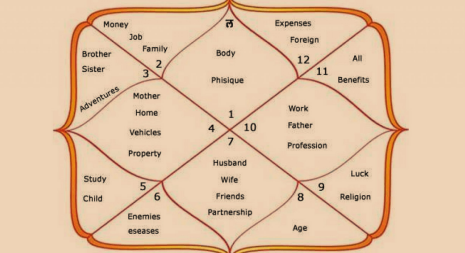
A horoscope gives an overall idea of a person’s life trajectory
The presence of a ‘bad’ planet does not necessarily mean that something bad will happen to us. Similarly, the presence of a ‘good’ planet does not mean that a positive event is definitely on the cards. In fact, it is interesting to note that the labels ‘good’ or ‘benefic’ and ‘bad’ or ‘malefic’ that are so often placed on planets are not because their influence might produce a certain kind of event in our lives. Rather, they relate to the psychological and spiritual impact that these planetary energies have on our consciousness.
But we must understand that the terms ‘good’ and ‘bad’ are simply terms used for classification and that it’s important not to take them too literally. The presence of a ‘bad’ planet does not necessarily mean that something bad will happen to us. Similarly, the presence of a ‘good’ planet does not mean that a positive event is definitely on the cards. In fact, it is interesting to note that the labels ‘good’ or ‘benefic’ and ‘bad’ or ‘malefic’ that are so often placed on planets are not because their influence might produce a certain kind of event in our lives. Rather, they relate to the psychological and spiritual impact that these planetary energies have on our consciousness.
Sai Ganesh Nagpal explains that, in astrology, each planet is associated with one of the three gunas: Sattva (purity, awareness, and clarity), Rajas (desire and action) and Tamas (darkness, inertia, and ignorance). All three gunas have different functions and are needed for the possibility and experience of life to unfold. He says, “Tamasic planets make us aware of our limitations and deeper fears through certain life events. We might choose to turn that awareness into pain and suffering. On the other hand, we might use that awareness as an inspiration to search for a deeper, inner truth, one that is truly beyond suffering. Rajasic planets, such as Venus, make us aware of our desires that we often bring into this life as part of our karmic journey. Sometimes, we can get caught up in an endless cycle of chasing desires. And yet, fulfilling desires in a dharmic way is an essential part of this experience of life. Sattvic planets, such as Jupiter, develop our more refined and subtle perceptions, allowing us to see the world beyond just appearance. They introduce us to higher ways of thinking and more conscious ways of living. Whether we are under the influence of a benefic or malefic planet, we always have a choice about how to use the powerful energy of that planet in a conscious way.”
Let us take an example. Saturn, or Shani, is perhaps one of the most feared planets of all because it is associated with challenges, hardships, ill health, failures, and dissatisfaction, among other things. But Dr Robert Svoboda, a Vedic astrologer and an ayurvedic physician, explains that when we are under the influence of Saturn, it is a time for discipline and to accept our fate with humility.
Saturn also has a great spiritual significance as it forces us to look within and introspect on the meaning of life.
Ultimately, astrology is an instrument that helps us understand how we may work with time and planetary energies to make our lives more fruitful and fulfilling. Chakrapani Ullal writes, “Vedic astrology seeks to impart mankind a tool with which to understand and live in greater harmony with nature to maximise opportunities for growth and minimise suffering.”
The power of remedies
One of the unique things about Vedic astrology is the idea of remedies. While remedies are most often associated with certain gems, stones, mantras, or pujas, there are also more subtle and personalised remedies that go far deeper and work on the level of our thoughts, intentions, emotions, and actions. Remedies can influence not just the expression of planetary energies but also the way in which we receive them.
So how do remedies work? They are channels through which we harness universal energies to create transformation. Remedies work on a very
subtle level, facilitating a certain interaction of energies that express themselves in the form of changes in our lived experience.
Chakrapani Ullal says, The presence of a ‘bad’ planet does not necessarily mean that something bad will happen to us. Similarly, the presence of a ‘good’ planet does not mean that a positive event is definitely on the cards. In fact, it is interesting to note that the labels ‘good’ or ‘benefic’ and ‘bad’ or ‘malefic’ that are so often placed on planets are not because their influence might produce a certain kind of event in our lives. Rather, they relate to the psychological and spiritual impact that these planetary energies have on our consciousness.
Ultimately, the fruit we reap from practising a certain remedy is experienced in our minds. In this sense, it is not about the remedies themselves but the feeling and intention with which we practise them. Sai Ganesh Nagpal says, “When an individual’s inner intention or sankalpa is joined to a practice, there is altogether another level of benefits that are derived. When you have faith in something, it

The presence of a ‘bad’ planet does not necessarily mean that something bad will happen to us. Similarly, the presence of a ‘good’ planet does not mean that a positive event is definitely on the cards. In fact, it is interesting to note that the labels ‘good’ or ‘benefic’ and ‘bad’ or ‘malefic’ that are so often placed on planets are not because their influence might produce a certain kind of event in our lives. Rather, they relate to the psychological and spiritual impact that these planetary energies have on our consciousness. will respond to you. Whether it is faith in an idea, individual, or higher power, human beings focus their energies through faith.”
There’s no doubt that for those who are interested in inner work and personal transformation, and seek astrological advice as a form of guidance, subtle remedies with a level of personal involvement and inner connection become more meaningful and effective than more impersonal, tangible means. Such remedies can include meditation practices and certain kinds of visualisations that relate to specific planetary energies and deities. Some remedies involve journeys or as Sai Ganesh says, “travelling to sacred spaces and performing pilgrimages, or tirtha, in order to physically connect with the energy of a devi or devata. Regardless of a person’s belief system, there will be places of high vibrational energy to which they are innately drawn, where their energy field will be most receptive to the flow of blessings.”
In today’s world of instant gratification, Sai Ganesh stresses the importance of patience and devotion when applying astrological remedies. “We might be tempted to ask for an immediate fix to our problems, but the power of remedies is truly
experienced in following a practice that comes from the heart and is performed with devotion. The practices are to be treated as a sadhana that is performed over time.”
It is true that certain things can be remedied while certain things cannot. In both cases, astrology can help us cultivate the attitude and inner strength to help us tide through the ups and downs of life with ease. Chakrapani Ullal says, “There is the destiny which cannot be changed, no matter what you do, the destiny which can be changed with hard work, and the destiny which can be changed with bringing changes into your life. Most of the things in one’s life can be changed. Death cannot be changed, but disease can be minimised. You cannot eradicate suffering, but you can reduce it.”
An empowered approach
So what mindset can we adopt to help us gain the most from an astrological reading so that the experience is valuable and empowering? Sai Ganesh suggests that we look at it as a form of guidance. He elaborates: “Firstly, it is important to find the right astrologer for you, someone whom you resonate with and trust on a deeper level. That way, when you approach them, you can go to them with reverence and a readiness to receive their guidance with an open mind. And yet, always remember that the information must filter through the wisdom of your own heart. Some advice in a reading may resonate with you, some may not. There will always be insights and values that you will be able to derive when you are in the presence of a trusted keeper of this knowledge.”
When we go to an astrologer for guidance or advice, we should make sure that we have specific questions about our current time and that we are able to articulate these clearly. This helps the astrologer to interpret the vast information in our charts in a way that is meaningful and useful to us.
Our relationship with planets and their energies does not have to give rise to dread or trepidation. In fact, Sai Ganesh advocates cultivating a personal relationship with planets and the symbols and deities they represent. He says, “There is something beautiful about forming a personal bond with the planets. For example, I might recommend that a person spends some time connecting with the calming energy of the moon at night, even if it means taking time out to look up at the full moon once a month. Gazing up at the star-studded night sky can also be a deeply humbling experience.” In this way, we can cultivate a beautiful relationship with the stars and planets that is not rooted in fear
but in wonder, love, and reverence. “When we form a bond of love with the luminaries in our cosmic world, where is the question of fearing them?”
Ultimately, we must understand that we are in charge of our lives. It is through our thoughts, deeds, and actions that we create our experience of life. Astrology acknowledges the power of a spiritual mindset, spiritual practices, prayer, and devotion in charting our destiny, and these must not be discounted. When there are things we are not able to change, we must look within, at our attitude and perception, and adopt a wider view of life. When there are things we can change, we must do so through our willpower and sustained effort. Astrology can help us in both cases, helping us cultivate a spiritual and empowered attitude, no matter what situation we encounter.
Perhaps this is best expressed by Chakrapani Ullal, who says, “Astrology is a science of indications only; it is not a fatalistic science. Therefore, people should have the idea that they have the power, if they want to, to bring amendments and changes to modify the influence by their effort and their willingness. When I give a reading, I say, “By using willpower, by gaining the grace of God or guru, we can change everything.” Otherwise, people misunderstand astrology by thinking Oh, it is in the stars. It is in the stars for only those people who do not want to take responsibility for their life.”
Along with writing, art and music, Nitya Rajagopal enjoys yoga, learning new languages, honing her French translation skills and exploring the subtle mysteries of life.
