

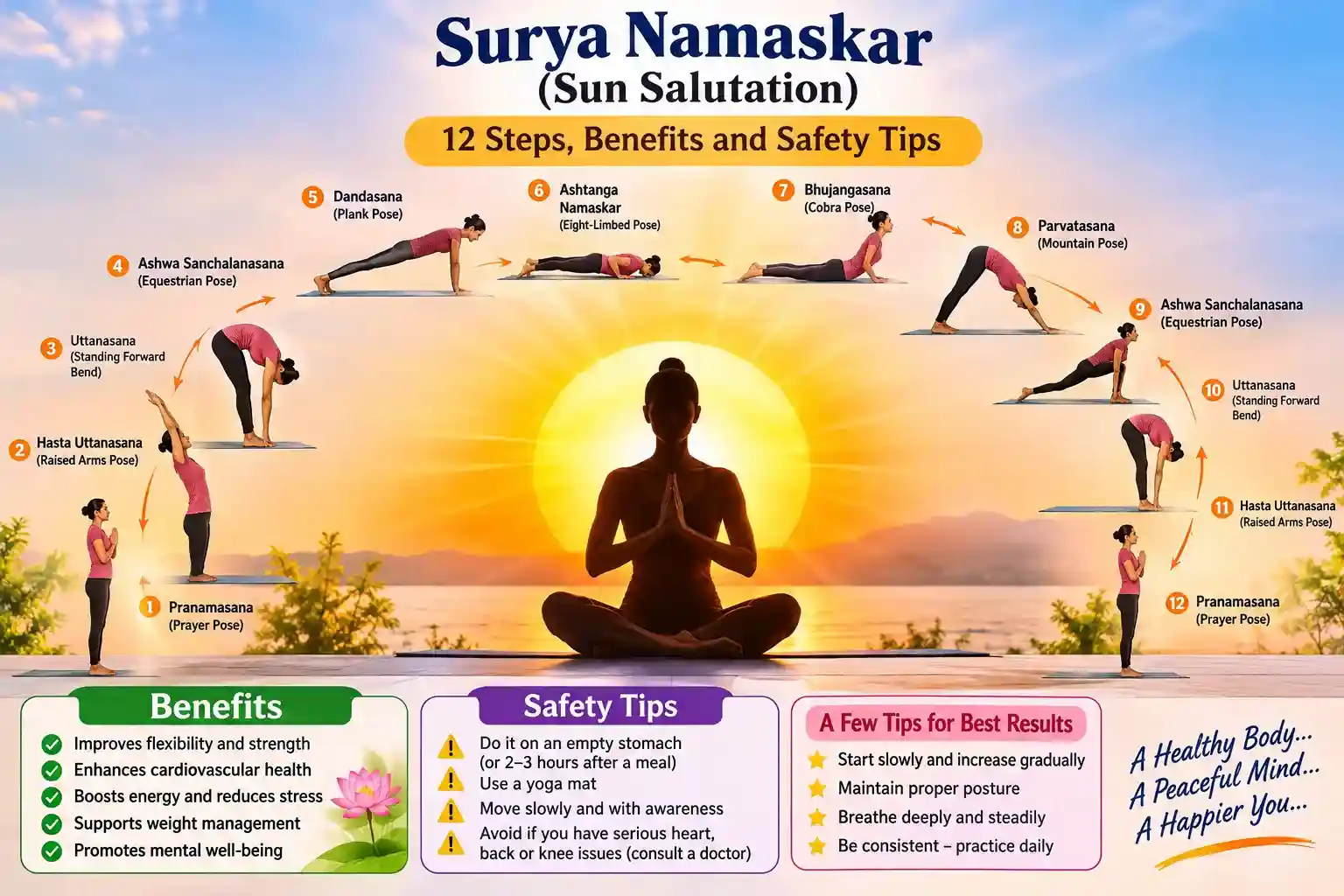
Surya Namaskar (Sun Salutation): 12 Steps, Benefits and Safety Tips
Surya Namaskar is a dynamic sequence of yoga poses, performed synchronously with breathing, and is among the most widely practiced sequences in yoga around the globe. In about 10 minutes it provides for movement of the spine in all directions, warms up the muscles, and establishes a rhythm for the mind. This article introduces the origins of the practice, outlines all 12 steps of the practice with breathing instructions, reviews the scientific evidence on the benefits of the practice, and provides tips for the beginners to start safely.
Key Takeaways
• Surya Namaskar is a practice that consists of 12 poses, and the whole practice includes two sets of poses, with each leg leading one.
• Perform every step synchronized with the breath, and start by performing a couple of sets slowly before accelerating.
• The available scientific evidence on the practice is encouraging, however, varies greatly in quality; thus, use it only as the exercise routine.
What Is Surya Namaskar?
The term Surya Namaskar is the combination of Sanskrit words – surya (sun) and namaskar (salutation). This practice is a series of 12 yoga poses, consisting of standing position with hands joined at heart level, forward bendings, lunge, plank, cobra, and the pose of the downward facing dog; the poses are always performed in the same sequence and synchronized with inhalation and exhalation.
It can be used as a warm-up prior to yoga practice, as a cardio and flexibility training or as a morning ritual. Due to the repetitive nature of the practice it is easily learned, and the speed can be adjusted depending on your fitness.
Origin and History
The worship of the sun has long history in Indian culture. Surya Namaskar (chapter) with 132 verses is included into Taittiriya Aranyaka of the Krishna Yajur Veda. However, the physical practice as we know it is relatively new. According to the review that was published, Suryanamaskar practice is a component of modern Yogic practice that does not have the status of asana in classical yoga practice. The popularization of this practice as daily exercise took place in early twentieth century due to yoga teachers and royal patronage, later the practice was modified and developed by Krishnamacharya, Sivananda and the Bihar School traditions of yoga.
Steps for Surya Namaskar: 12 Postures
It should be practiced on a nonslip mat preferably with an empty stomach and in a well-ventilated place. The following steps are done when the right leg is the first leader. You repeat the steps with the left leg to finish one round.
1. Pranamasana (Salutation Pose). Stand upright with feet together and palms folded at the chest. Exhale and distribute weight evenly.
2. Hastauttanasana (Raised Arm Pose). Inhale and raise your arms up along with bending backward from your waist and keeping neck loose.
3. Hastapadasana (Standing Forward Bend Pose). Exhale while bending your body from your waist and touching the floor with palms. Bend the knees if you experience tightness in the hamstrings.
4. Ashwa Sanchalanasana (Equestrian Pose). Inhale and extend the right leg backwards and bend the knee. Open your chest and look upward.
5. Parvatasana (Mountain Pose or Downward Dog). Exhale and raise the hips up and bend backward in such a way that it forms an inverted V.
6. Ashtanga Namaskara (Eight Limbed Salute). Hold your breath momentarily while taking the knees, chest and head towards the floor in inverted V posture.
7. Bhujangasana (Cobra Pose). Inhale while moving forward and bending your body from the chest.
8. Parvatasana (Mountain Pose). Exhale and bend the body again in inverted V posture.
9. Ashwa Sanchalanasana (Equestrian Pose). Inhale while moving forward the right leg and lowering it between palms. Back knee should remain bent.
10. Hastapadasana (Standing Forward Bend Pose). Exhale while coming back to standing forward bend posture.
11. Hastauttanasana (Raised Arm Pose). Inhale and come to upright position with straight back.
12. Pranamasana (Salutation Pose). Exhale while lowering your arms to chest level and coming to stillness.
This finishes one round. Repeat postures 4 and 9 with left leg to complete the round.
Breathe Technique at a Glance
Action Breathing
Arms up, back bend, lunge, cobra Deep inhalation
Forward bend, down dog Deep exhalation
Eight limbed salutation Hold momentarily
Benefits of Surya Namaskar
Surya Namaskar is often described as a whole-body workout, and evidence supports some of that. It also deserves a careful reading, because study quality varies.
- Fitness and flexibility. The sequence stretches the hamstrings, hips, spine and shoulders, and it builds endurance in the arms, core and legs. A review of studies in children reported gains in muscle strength, endurance and flexibility, along with improved lung measures and lower blood pressure and heart rate, although the evidence had a high risk of bias. bvsalud
- Heart and lung engagement. Done briskly, the flow raises your heart rate and breathing, which gives light to moderate cardio exercise.
- Mental wellbeing. The steady rhythm of breath and movement can help you feel calmer and more focused.
- Posture and body awareness. Alternating forward and back bends mobilizes the spine and builds awareness of alignment.
- Overall effect. A 2026 systematic review found promising but varied evidence that Suryanamaskar may improve physical fitness, physiological function and psychological wellbeing, with results differing widely across study designs. citedrive
Claims about curing diseases or dramatic weight loss go beyond the evidence. Calorie burn per round is modest, so consistency and your wider lifestyle matter more than any single practice.
Best Time and Frequency to Practice
Early morning on an empty stomach is the traditional choice, ideally facing the rising sun, since the body feels fresh and the stomach is light. You can practice at other times as long as a meal was at least two to three hours earlier. Beginners can start with three to four rounds, 3 to 4 days a week, and add a round or two as strength and stamina improve. Finish with a few minutes of rest in Savasana so the heart rate settles.
Beginner Tips and Modifications
- Move slowly at first and learn the order before speeding up.
- Bend your knees in forward folds to protect the lower back.
- Drop your knees to the floor in the plank or push-up phase if your arms are not yet strong.
- Skip the deep backbend and keep the cobra low if your back feels tight.
- Step the foot back instead of jumping if you are new or recovering from an injury.
- Keep a short, steady pace, and pause anytime you feel dizzy.
Common Mistakes to Avoid
- Holding the breath through the whole round.
- Rushing, which strains joints and breaks the flow.
- Collapsing the shoulders or sinking the lower back in the plank.
- Overarching the neck in the backbends.
- Practicing right after a heavy meal.
- Always leading with the same leg, which creates an imbalance.
Who Should Be Careful
Check with a doctor before starting if you are pregnant, have high blood pressure or heart disease, a hernia, a recent surgery, wrist, shoulder, neck or back problems, or severe fatigue. Modified, gentler routines or a qualified teacher’s guidance can make the practice safer in these cases. Stop at once if you feel chest pain, dizziness or sharp pain.
Poses to Combine with Surya Namaskar
Use the sequence as a warm-up before standing poses such as Trikonasana or Virabhadrasana, or follow it with seated forward folds, spinal twists and Savasana. Pairing it with breathing practice such as Anulom Vilom afterward helps the body cool down.
Frequently Asked Questions
What are the 12 steps of Surya Namaskar?
The steps are Pranamasana, Hastauttanasana, Hastapadasana, Ashwa Sanchalanasana, Parvatasana, Ashtanga Namaskara, Bhujangasana, Parvatasana, Ashwa Sanchalanasana, Hastapadasana, Hastauttanasana and Pranamasana. They run from a prayer stance through bends, a lunge, a plank-like phase and a cobra, and back to prayer. Repeat with the opposite leg to complete a round.
How many Surya Namaskar should I do daily?
Beginners can start with 3 to 4 rounds and build up gradually. Many regular practitioners do 6 to 12 rounds, and some do more for special occasions, but there is no need to chase a high number. Quality of movement and breath matters more than count, and you should stay within your comfort level.
What is the best time to do Surya Namaskar?
Sunrise or early morning on an empty stomach is traditionally preferred, because the body is rested and the stomach is light. You can also practice in the evening if at least two to three hours have passed since your last meal. Pick a time you can keep consistently.
Is Surya Namaskar safe for everyone?
Not necessarily. It suits most healthy adults when done with attention to form, but people with high blood pressure, heart conditions, hernias, joint or spine injuries, or who are pregnant should seek medical advice first. According to the National Center for Complementary and Integrative Health, yoga is generally considered low-risk for healthy people when practiced appropriately, and people with health conditions should talk with their healthcare provider and work with a qualified instructor.
By Umesh Kumar Khiri

