

June 2013
By Pradeep Darooka
On his spiritual journey, Pradeep Darooka discovers the joy and freedom of returning to traditional Indian attire instead of aping the Western dress code
 |
When I was in the corporate world in the US, the dress code was quite simple – suit and tie, every day. For formal get togethers, client dinners, banquets, and other similar occasions, it was black tie, i.e. tuxedo. I hated it. With the IT boom, things became a bit more relaxed, with casual Fridays, when one could drop the suit and tie, and dress less formally. What a relief. At least for one of the five work days, one could breathe. There was some hope for the vishuddhi chakra to open up.
When I dropped out and returned to India, I was looking forward to a gradual migration to the blissful, comfortable world of kurta pyjama. However, I was in for a shock. As we say in Hindi, ‘Angrez chale gaye lekin angreziyat chod gaye.’ (The English may have left but their culture remained). In the hot, humid climate of Mumbai and most of India, I saw Indian men dressed in exactly the same attire I had yearned to drop off for years in the US. At least the cool climate there provided some justification and necessity for that attire. I did not see any hope for any of the chakras, not just the vishuddhi, to open up here.
Naked truth
Fortunately, I had embarked on a journey with many unknowns along the way. One did not know what would come next. One kept going along with the flow that is both sublime and subtle. As I got deeper into Advaita and Zen, the common theme that emerged clearly was the inevitable need for the self to break free from all shackles, and years of hardened conditioning, and to soar like a free bird. As the consciousness rose higher, getting rid of unnecessary, irrelevant, and burdensome habits happened naturally. Man is born without a stitch on his body and that is the only time in his life when he is at his pristine, pure self, born out of consciousness, and connected to consciousness. It is downhill all the way after that. In tribal societies all over the world, children remain without clothes well into adulthood, and in many of these societies even through their entire life. Certain tribal societies have been corrupted by the mores of so-called ‘civilised’ people who have insisted that it is immoral to reveal certain parts of your body to others, no matter how uncomfortable or unhealthy it may be to cover up. One has to look at our sadhus, monks, ascetics, and others who have either renounced the world, or live fully rooted to Mother Earth, and see their almost naked self. They have nothing to hide. One has to look at the many realised individuals who have walked the lands of India and elsewhere almost threadbare, Ramana Maharshi, Mahavira, Buddha, Jesus Christ, and many more, and wonder why.
Going the Indian way
While I was not quite ready to shed it all, changes were taking place. As the chakras start opening up and become charged and energised, they need to breathe. They cannot breathe when one is covered in tight clothing day and night. The body, the skin, the hair, and the bones, all need sun and fresh air to recharge all the cells, and keep them fully vibrant and charged. They need to connect with the moon, the planets, and the stars, and imbibe all the energy that radiates from them. Tight and layered clothing inhibits this. Why is it that during yoga, pranayama, meditation and other healing exercises we are asked to wear loose comfortable clothing? Why is it that when we come back from a party all clothed and dolled up, the first thing we do is ‘take it all off?’ It is human nature. It wants to breathe. So why should we not want to breathe 24/7? Why only for a few hours in a day? Moreover, especially why not at night while sleeping, when our body is busy rejuvenating and recharging all its cells?
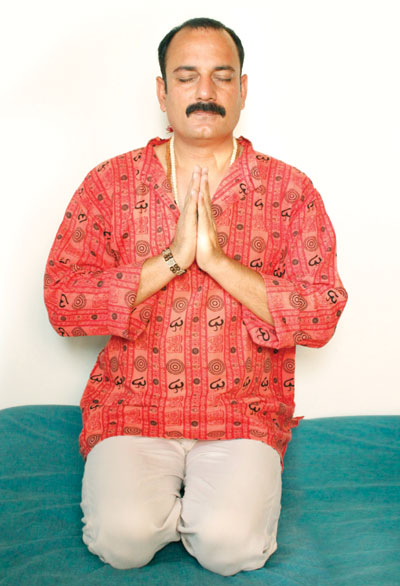
My suit and tie had long given way to simple trousers and open-necked shirt. Kurta and pyjama had gradually made their inroads into my wardrobe, and not just as nightwear. Conventional trousers with zipper and belts gave way to drawstring pants with loose bottoms. Collared shirts gave way to collarless shirts, tunics, kurtis with short sleeves, or long flowing sleeves with no cuffs. Dress shoes were history long time back. I had discovered the pleasures of sandals and chappals, perfect for India where one needed to take them off frequently. For the cooler climates, I discovered the beauty of the shawl, resplendently available in a multitude of designs, fabrics, and colours in different parts of India. Very soon, I had an enviable collection. The kurta pyjama (in its many variations) became the attire of choice for me almost everywhere, whether it was at home, at a party, a wedding, formal occasion, business meeting, workshops, satsangs, or travel. I was denied access to certain clubs, which did not trouble me. Invitations asking for formal dress were declined, and as a result, became a trickle. I started breathing easier and deeper. Sleeping in the buff became normal and with that came peaceful sleep.
It was not too difficult to establish a correlation between our clothing and our health and wellness.
Natural is ‘in’
First, since our body is a product of Mother Nature, and made up of the five elements, any alien element like synthetic, nylon, rayon, or chemically treated fabric will have an adverse effect on us, no different from any toxic or inorganic substance entering our food chain and blood stream. The impact is rarely immediate, except in the case of allergies of certain kinds, but happens nonetheless. Once I realised this, it was only cotton and linen for me. I discovered the natural, organic beauty of khadi and the way it allowed my body to breathe. Along the way, I discovered fabrics made from bamboo and hemp, and I started breathing even deeper and easier. Once I saw for myself how silk was being woven, by boiling the live cocoons in hot water, silk dropped out of my wardrobe. Even in the coolest climate, I found wool to be unnecessary. Layered cotton clothing of various textures was sufficient.
Secondly, those of us who belong to a certain generation may remember or know that our parents never wore any underwear, including no bras for women. My father always wore a dhoti and my mother always wore a saree, two of the most practical and comfortable pieces of attire in the world. Underwear and bras (corsets and the like from the Victorian era were the origins of this) were yet another gift given to the ‘uncivilised world,’ by the ‘civilised English,’ along with the chair, the potty, the heels, and many others. It did not take very long for the chakras to be imprisoned. This article is not focused on an in-depth analysis of the correlation between various lifestyle diseases (in particular breast cancer and other cancers of the organs around the lower chakras) that originated in the 20th century and the wearing of certain pieces of clothing. It suffices to say for now that the correlation exists.
All of these dropped off for me, layer by layer, one by one. I felt a sense of freedom, once again soaring like a free bird, ever higher and higher. The spiritual journey continued.
