

August 2012
By Nandini Sarkar
Travel to Cambodia brought Nandini Sarkar in touch with a people whose horrific past has failed to wipe the smile of their faces
 |
Angkor Wat,’ said Aunt Manika, the family globetrotter, thoughtfully. “Among all that I have seen in foreign countries I have visited, the Angkor Wat in Cambodia, has impressed me the most.” This sealed it for my mother, who trusted her sister’s judgement implicitly. We wanted to take mother for a vacation, after her devoted labours for our daughter Aishi’s board exams. My brother’s family joined us from the US, and so it came about that a big gang of 11 set out for a seven-day, whirlwind tour of Malaysia, Thailand, and Cambodia. In tourism brochures, Cambodia is heralded as ‘The Land of Wonders,’ but for us, it soon became, ‘The Land of Smiles.’ People in Malaysia are somewhat aloof, and in Thailand, polite but reserved. Cambodians are at the other end of the spectrum – warm, helpful and gregarious, a novelty for the foreign traveller, who expects to be lost in the overseas cosmopolitan jungle, without a guided tour package.
Smiles all the way
The world famous Angkor complex is situated in the city of Siem Reap, a six-hour journey from the Cambodian capital, Pnomh Penh. Years of civil war and the corrupt Khmer Rouge regime have made Cambodia an impoverished country.
Surprisingly, Cambodian faces do not carry any overt sorrow or bitterness from the past. Everyone smiled constantly, right from Kuru, the front office manager of the Smiling Hotel & Spa, who informed us on arrival that we had been upgraded to executive suites, to Sar Wan, our Angkor Wat tour guide, who told us that four of his family members had been killed in land mines left behind from the civil war. Cambodians talk of Bodhisattva, compassion, piety and forgiveness, as easily as Indians talk of nirvana, and they seem to embody this in their everyday life, as they rebuild Cambodia from its horrific Khmer Rouge past.
Angkor delights
Angkor, built by the Hindu king, Suryavarman II, in the early 12th century, as his capital city, is spread over an expansive 700-plus hectares of land. A combination of secular and religious buildings, Angkor was the largest pre-industrial city in the world, and at one time housed 7,50,000 citizens. Today, Angkor is a UNESCO world heritage site, and will take days to explore. Most of what remain of Angkor are its monumental temples, most famously that of Angkor Wat. Angkor Wat was dedicated to the Hindu god Vishnu. Vishnu’s churning of the Ocean of Milk, as the Kurma Avatar, is a prominent theme of the Angkor complex, with rock sculptures of both the devatas and asuras involved in the Samudra Manthan. Vasuki, the serpent god, the monkey gods, and the heavenly maidens Apsaras, are other prominent sculptures dotting the Angkor relief. When Buddhism permeated the region at the end of the 12th century, Angkor became a center of Buddhist worship. Angkor Wat is designed to represent Mount Meru, home of the devas, in Hindu mythology. It is made of three rectangular galleries, each raised above the next, surrounded by a broad moat and an outer wall, 3.6 kilometres long. Modern travellers, especially lovers of history, and archaeology, seem to be transported, as they explore the colossal Angkor structures. Tourists prefer to troop in at dawn and dusk, when the structures seem to come alive. They climb up the steep, narrow stone stairs to see the supremely serene, reclining Buddha in the Angkor Wat temple, to see the Bayon with its mystical, four headed ‘smiling towers’ to gape at the eerie Ta Prohm, where monster trees, creepers and stranglers, weave in and out of the masonry, having felled huge stone walls with their massive roots.
Sunset on the Tonle Sap
 Nandini and husband Sushobhan with Bill Morse at LandMine Museum |
One of the highlights of our visit was a boat ride down Cambodia’s Great Lake, the Tonle Sap, to see the famous floating markets. Cambodia’s Great Lake is a huge dumbbell-shaped body of water, swelling to an expansive 12,000 sq km during the rainy season. Floating villages and pretty stilted houses line the Tonle Sap. Silhouetted on the deck against the orange glow of the setting sun, Sanjukta, my sister-in-law, sang a Tagore song, thanking the Divine for his bounty and for the many wishes fulfilled. It was an unforgettable picture-frame of peace, thankfulness, and harmony.
The Land Mine Museum
My husband and I decided to visit the Cambodian Land Mine Museum, located mid-way between Siem Reap and the Angkor Park. We chose this over the more conventional Angkor Museum that houses relics and artefacts, because Sushobhan wanted to know how the Cambodians could remain so happy and positive, despite the ravages of the recent civil war, and the genocide committed by the Khmer Rouge.
| He thought he would go mad if he spent more time helping rich people become richer, or sit around in bars, drinking with rich clients | ||
A 40-minute ride later, we were at the Land Mine Museum, reading about the Cambodian Gandhi, Aki Ra. Aki Ra was a child soldier, enlisted by the Khmer Rouge at age ten and given a rifle that measured his own height. Soon after, he was taught to lay land mines, which are explosives concealed just under the surface of the ground and designed to explode by pressure from a passing vehicle or person. For three years, Aki Ra worked as a mine layer for the Khmer Rouge regime, and then did the same job for the Vietnamese army that overthrew his village. An estimated six million land mines were laid in Cambodia during three decades of conflict and three million land mines are still active today in Cambodia.
When the United Nations came in the early 1990s to help restore peace to Cambodia, Aki Ra saw an opportunity to begin undoing the damage he and others had done. He started training with the UN and helping to clear mines. A CNN Top 10 Hero for 2010, Aki Ra estimates that he and his group have cleared more than 50,000 land mines and unexploded weapons. “I want to make my country safe for its people,” he says. Many of Aki Ra’s recovered land mines are on display at his museum in Siem Reap. Also at the museum is an orphanage that Aki Ra and his wife Hourt, started about a decade ago. Roughly, 100 children, some injured by land mines, have been cared for over the years. Aki Ra serves as a beacon of hope for several hundred villages where Government aid on de-mining has still not reached, travelling nearly 25 days a month to support the de-mining efforts at these villages, and spreading the cause of education to alleviate the suffering of the common people.
It tolls for thee
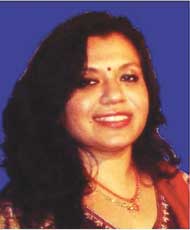 Nandini Sarkar is co-founder, C-Quel, a management services company. She is a lover of the spiritual masters and follower in the Kriya Yoga tradition. |
As we entered one of the museum rooms, a voice called out to us in clear, perfect English, “If you have any questions, I can help.” A tall, lean American, with the bluest pair of eyes, stood enquiringly behind us. Bill Morse’s story turned out to be as intriguing as the Land Mine Museum, and a fitting finale to a vacation from which we had sought inspiration, as much as entertainment. A decade ago, Bill had heard about Aki Ra from a friend in the States. Moved by Aki Ra’s story, he came to Cambodia for a three-month stay, and ended up staying for the past nine years. He actively supports Aki Ra’s de-mining mission, along with his wife Jill, who works as a teacher at the orphanage. Bill was a prosperous businessman in the States. One day, he felt he would go mad if he spent more time helping rich people become richer, or sit around in bars, drinking with rich clients. Around this time, he met Aki Ra. Cambodia, despite its stark poverty, became home. I asked Bill what had motivated him to give up a life of luxury, and cross over to Cambodia. He quoted John Donne, saying that he had his poem on his study table from the time he was a high school student:
‘No man is an island, entire of itself.
Each man’s death diminishes me, for I am involved in mankind.
Therefore, send not to know for whom the bell tolls, It tolls for thee.’
Bill came to Cambodia when he was 55 years old, and stayed back with the blessings of his mother, a devout Christian, who asked him not to waste any more time, when he requested her consent to stay back in Cambodia, to help Aki Ra. I mentioned to him that according to the Vedic system, life should be divided into four ashramas or stages. Fifty years is the age at which a person is advised to withdraw from worldly activities, and devote time for the good of the community. Bill’s life seemed to fit the Vedic mould; he had been a student, a householder, and a businessman, and at 55 years, he had become a crusader for mankind. I asked Bill if he and Jill ever thought of going back. His voice dropping slightly, he said, “The villagers are building a stupa for Aki Ra, which will house his mortal remains when he dies. My remains will also lie in that stupa.”
“Mr Morse,” said our teenaged son, Riddhiman, “Meeting you has been more inspiring than the Angkor ruins. I can never forget this meeting.”
